Switch back to main site : Click Here

.jpg)
By Jesse Rubenfeld, founder of FinOptimal. I'm an accountant who got tired of the month-end grind and built my way out of it — then built a company around what worked.
Most accountants don't dread their monthly close because the accounting is hard. They dread it because of everything around the accounting — the maintenance, the rebuilding, the re-keying. The actual journal entry is usually straightforward. It's getting to it, and proving it still ties, that eats the week.
I know, because I lived it — closing real client books every month. We don't need a faster version of the same grind; we need a structurally different process, where month-end stops being the thing you brace for. This is what I built FinOptimal for. I call it the continuous close. Here's what it is, how it differs from the way most teams work today, and why it's worth the change.
Think about a traditional month-end close. The work isn't the accounting — that part is usually fine. The work is the maintenance around it, and it comes in three flavors.
Recognition schedules you rebuild every month. Prepaids, deferred revenue, depreciation, payroll accruals — each one its own workpaper, rolled forward by hand and reconciled back to the balance sheet to prove it still ties.
Recurring and complex JEs you re-key every month. Loans, payroll allocations, Stripe and POS data, lease entries, misc reclasses — the same entries built in a spreadsheet and re-typed into QBO, hopefully correctly.
Reports and reconciliations you rebuild every month. Export from QBO, paste into your workpaper, tie out the balance sheet, format the P&L for the client — then do it all again next month.
Every one of these is a workpaper someone owns. Miss a month, inherit a messy version, or hand it to someone new, and the drift between the workpaper and QBO is where the late nights come from.
The consequences are always the same three:
For a firm, this scales badly: ten clients means dozens of workpapers to babysit, and capacity gets capped by spreadsheet maintenance. For an in-house finance team, it's the exhaustion tax on the one close that matters most — by the time it's done, you're spent, and the strategic work that actually gets noticed gets whatever's left.
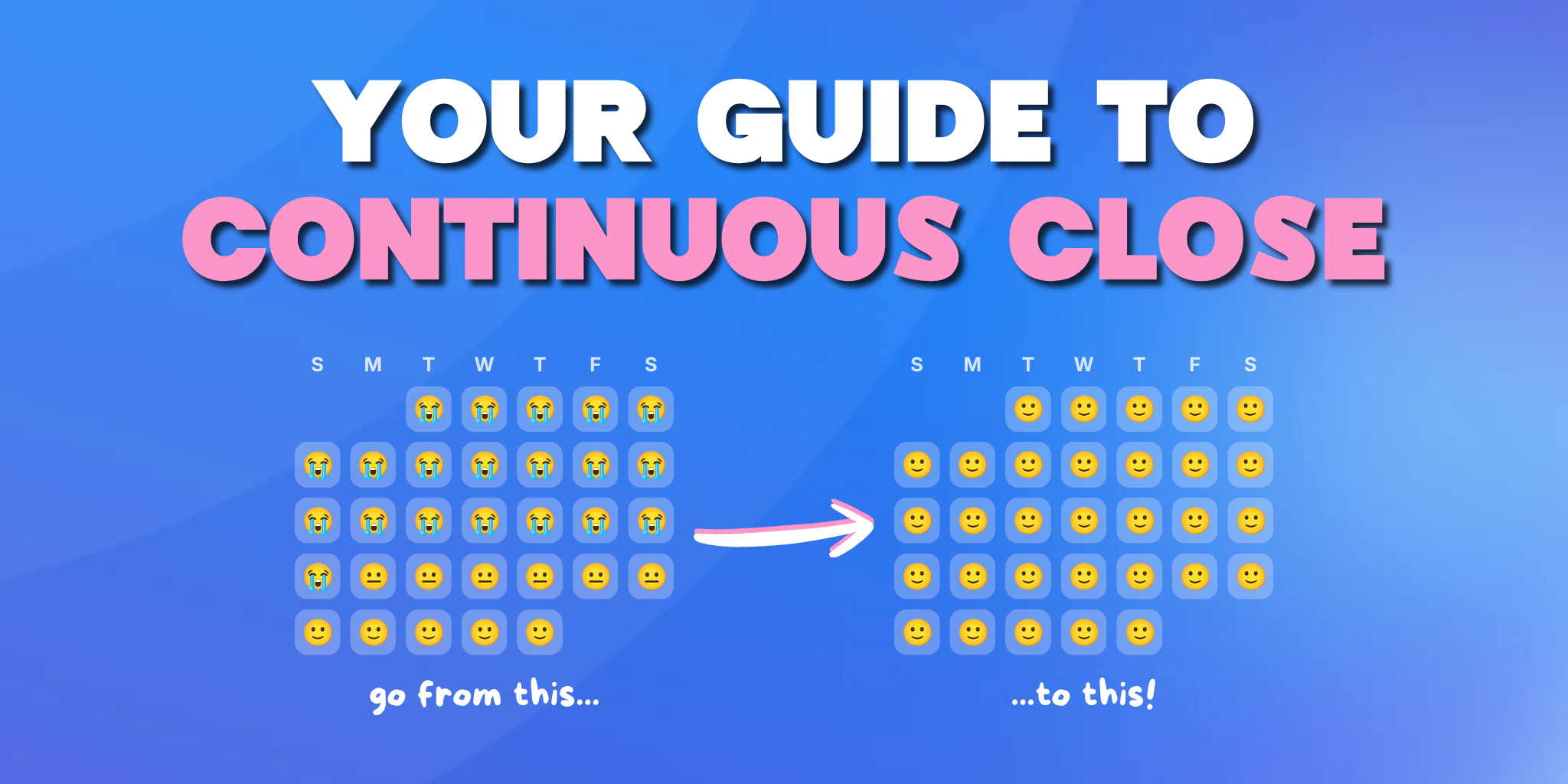
In a traditional close, month-end is a build. You update the prepaid schedule, post the recurring JEs, pull the reports, tie out the balance sheet — all at once, under a deadline.
In a continuous close, that work already happened as the month ran. The schedule doesn't live in a spreadsheet that a person updates. It lives in the tool. You record activity once, correctly, and the period-by-period entries post themselves going forward. Month-end is review and confirm: you're checking that what should have posted did, resolving the handful of exceptions the tools flag, and signing off.
A continuous close has three components:
The single clearest way to feel the shift: reconciliation becomes a check, not a rebuild. You're confirming the books tie — not reconstructing the schedule to find out whether they do.
Month-end stops being when you build, and becomes when you review and confirm.
Everything else is mechanics in service of that.
And there's a deeper structural change underneath it. A traditional close scales with the number of spreadsheets you maintain. A continuous close scales with the number of exceptions — which is a far smaller number, and one that doesn't grow just because the book got more complex. The work stops scaling with your spreadsheets and starts scaling with your exceptions.
Across 50 client books, that difference compounds: an exception list scales far better than 50 sets of workpapers ever will.
The mechanics are the means. Here's what you actually get out of a continuous close.
You catch issues before they become serious. Problems surface as the month runs, while there's still time to deal with them — instead of all at once in a month-end scramble.
You can trust your numbers mid-month, and put them to use. The books are close-ready continuously, so you're not waiting until the close is done to know where things stand. The data is usable when you need it, not three weeks later.
You spend less time on cleanup and data entry, and more on the work that matters. The rote work runs itself. Your people spend their time on judgment, not transcription.
But the payoff that matters most at the team or firm level is one people rarely plan for: standardization.
When every close runs the same way, on the same tools, it stops being tribal knowledge locked in one person's spreadsheets. Anyone can open the file and speak the language — they know where the schedules live, how the JEs post, which reports tie out to what. New clients and new hires onboard onto a known process instead of a bespoke setup only one person understands.
This is the quiet answer to a question every team knows to worry about: what happens when the person who owns the spreadsheets leaves? In a continuous close, the process doesn't leave with them. It's in the system, not in someone's head.
A continuous close is a way of working, not a product. But it's a way of working that needs the right infrastructure underneath it. I built three products to do that work — each one inside QBO and the spreadsheets accountants already live in, not bolted on top as another system to manage.
Accruer — the recognition engine. Automates prepaids, deferred revenue, fixed assets, and payroll accruals. You tag the activity once; Accruer calculates and posts the recognition entries period after period, and builds the schedule you reconcile against. Recognition posts without you.
Read more about Accruer →
Booker — the two-way sync. Posts complex and recurring journal entries from a spreadsheet straight into QBO in a single run — the loans, allocations, and reclasses you used to rebuild and re-key by hand.
Read more about Booker →
Wrangler — live reporting. Pulls QBO data into Sheets that update live, builds custom reports, and refreshes the reconciliation for you — no exports, no reformatting, no pasted-in workpapers.
Read more about Wrangler →
Together they make a round-trip: pull from QBO, transform in the spreadsheet, push back — with Accruer running recognition underneath the whole time. That round-trip is what standardizes the close instead of leaving it in someone's head.
FinOptimal grew out of my own accounting firm — these tools were built, broken, fixed, and refined while closing real client books every day. This isn't a theory about how accountants should work. It's how my team and I actually close.
Running the continuous close on the tools I built, I doubled my firm's client capacity — the same team carrying twice the book, without adding headcount.
With the right tools, reviewers spend month-end reviewing exceptions, not rebuilding schedules. New clients onboard onto a known process instead of a one-off setup. And the close gets shorter and more reliable every month, because the system carries the repeatable work and the people carry the judgment.
That's the continuous close — and it's the foundation everything else we build is built on.
Want to implement a continuous close in your own team? Book time with our product specialists.