Switch back to main site : Click Here

Every firm owner knows the math: Every hour an accountant spends on manual close work is an hour that can't be billed and can't be spent taking on another client. And it isn't one close — it's every close, across thirty or fifty or a hundred client books, every single month. That multiplier is the whole business. It's also the ceiling.
You can only grow a firm two ways: add people, or give the people you have more capacity. Hiring is expensive, slow, and hard right now. So the real question nagging every firm owner: how do I take on more without breaking the team I've got?
Most software companies in this space are built by engineers who talked to accountants. FinOptimal is the other way around.
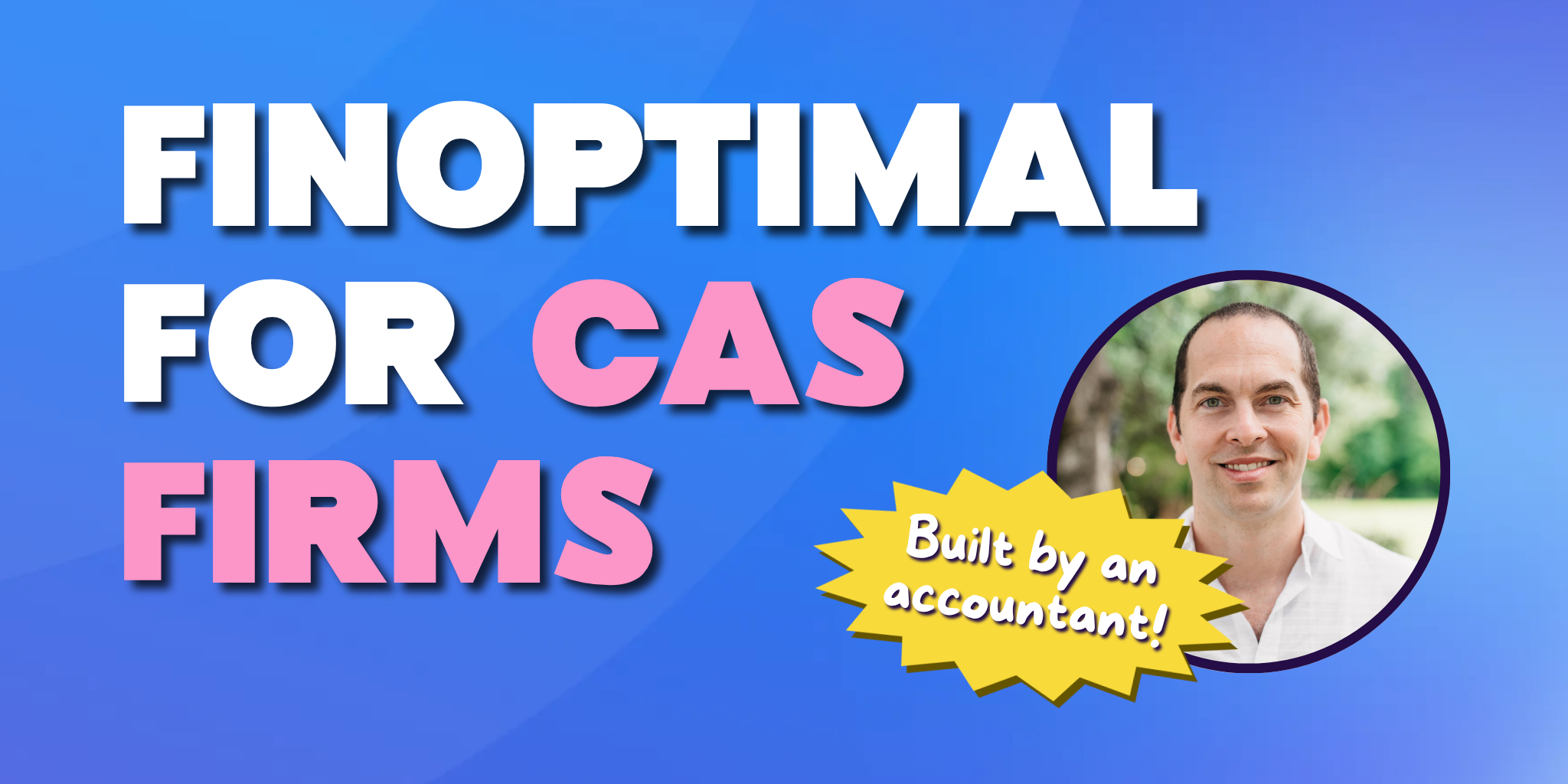
Jesse founded FinOptimal as an accountant-developer — an in-house Controller and CFO whose edge was that he could write code. He automated his own bank reconciliation, AP invoice processing, expense management, payroll accounting, monthly close entries, and reporting, back when that meant parsing TriNet payroll PDFs into an Excel tool that spat out an IIF file for QuickBooks Desktop.
That instinct — the accountant building the tool he built to escape the grunt work — is the whole origin of the company.
The first five clients were the hardest, and not because their books were complicated. It's that software written for one employer only has to work once; software meant to generalize across five different firms has to survive the edge cases — and the edge cases are what separate good software from great. And he learned firsthand just how complex it is to build automation that comfortably covers the vast majority of real-world client books.
That's the person behind our products. Not a vendor who studied the problem — an accountant who's still in it, running it on his own firm right now.
For an in-house team, the cost of a slow close is opportunity and exhaustion. For a firm, it's those plus a third thing that's easy to miss until it bites: key-person risk that quietly caps your growth.
Here's how it happens, in Jesse's own experience. A workflow starts clean. Over the years it accumulates edge cases and enhancements until it's a web of formulas that only the person who built it can untangle. Now that client can't be handed to another accountant without a painful, days-long knowledge transfer — if it's possible at all. Capacity that should be fungible gets siloed inside one person's head and one person's spreadsheet. And a firm whose accountants can't hand clients back and forth is a firm that struggles to grow, no matter how good any individual is.
That's the trap. The manual, personalized brilliance that gets a firm through this year is the exact thing that stops it scaling next year. Every heroic spreadsheet is a future bottleneck with a name attached to it.
And the pressure on all of this is rising. The firm down the street experimenting with automation isn't a hypothetical anymore, and every firm owner feels the low-grade anxiety that they might already be behind. Most aren't asking whether to automate. They're wondering how far back they are.
If you've looked at automating the close across your book and haven't committed, it's usually one of these. Here's the honest answer from someone building the thing on his own firm as we speak.
Reasonable. The market is loud right now, and most of what's aimed at firms is either a practice manager that organizes the close or a bolt-on that automates one narrow slice and adds three steps around it.
The distinction that matters: some tools manage the close, and some execute it. A practice manager tracks status, flags uncategorized transactions, and keeps the team aligned — genuinely useful, but the actual accounting still happens by hand in QuickBooks. FinOptimal is built inside the work itself, not around it. It's QBO-native, not middleware sitting on top. Most tools reach toward the general ledger from the outside; FinOptimal starts there. For a firm whose bottleneck is the accounting itself — the accruals, the journal entries, the reconciliations — that's the difference between a tool that helps you watch the work and one that does it.
You could — and if anyone would tell you so, it's the guy who did exactly that. But coming from Jesse, who spent years building this, the hard part isn't the first build — it's everything after.
A homegrown tool is now something you own, debug, and maintain forever, on top of running a firm. Worse, it recreates the exact key-person risk you're trying to escape: the automation lives in one person's head, and the day they leave, it becomes a black box nobody can safely touch. The hard part of automation was never writing it once. It's keeping it working across every client and every QuickBooks change, without it silently rotting into a liability. That's the part buying solves and building doesn't.
Automating and modernizing processes does take real work. But the thing that makes it worth the project is where the leverage lands.
One dedicated project means pay off for your entire firm, fixing one class of problem across your entire book in a single pass, instead of client by client. His own proof point is AutoRec, the ancestor of what's now Reconciler — being able to see book-versus-bank outages and update the books directly from a spreadsheet, with copy-paste and formulas and conditional formatting doing the work. The last time he reconciled without it, he burned a full day hunting a fifty-cent discrepancy in a haystack of hundreds of transactions. Now that's a single pass.
That's the shape of the payoff. QA and cleanup that used to multiply against your book — one problem times a hundred clients — collapse into one operation. The bigger your book, the more that leverage compounds. It needs an owner and some dedicated time. It does not need you to boil the ocean.
Every one of those objections comes back to the same buried belief: that the manual grind is the price of running a firm, and the only way past the capacity ceiling is more people. It isn't. The grind is an artifact of tools that were never built for how accountants actually work — and the ceiling is a function of the grind, not the market.
FinOptimal is building for a close that's automated end to end, with a human in the loop only where a human belongs: reviewing the financials, approving money movement, and talking to the client. Everything before that — the reconciliation, the entries, the workpapers, the QA — is plumbing. And plumbing shouldn't be where your accountants spend their scarce, billable, capacity-defining hours.
That's what FinOptimal is for. It's QBO-native, built by an accountant-developer who's lived every part of this and is proving the capacity thesis on his own book as he builds it. It's honest about the work involved and honest about what's still being proven. And it points at the one outcome every firm owner actually wants: more clients, without more headcount, without the key-person risk that turns this year's hero into next year's bottleneck.
To see a custom demo of FinOptimal, speak to one of our CPAs.