Switch back to main site : Click Here


At a glance
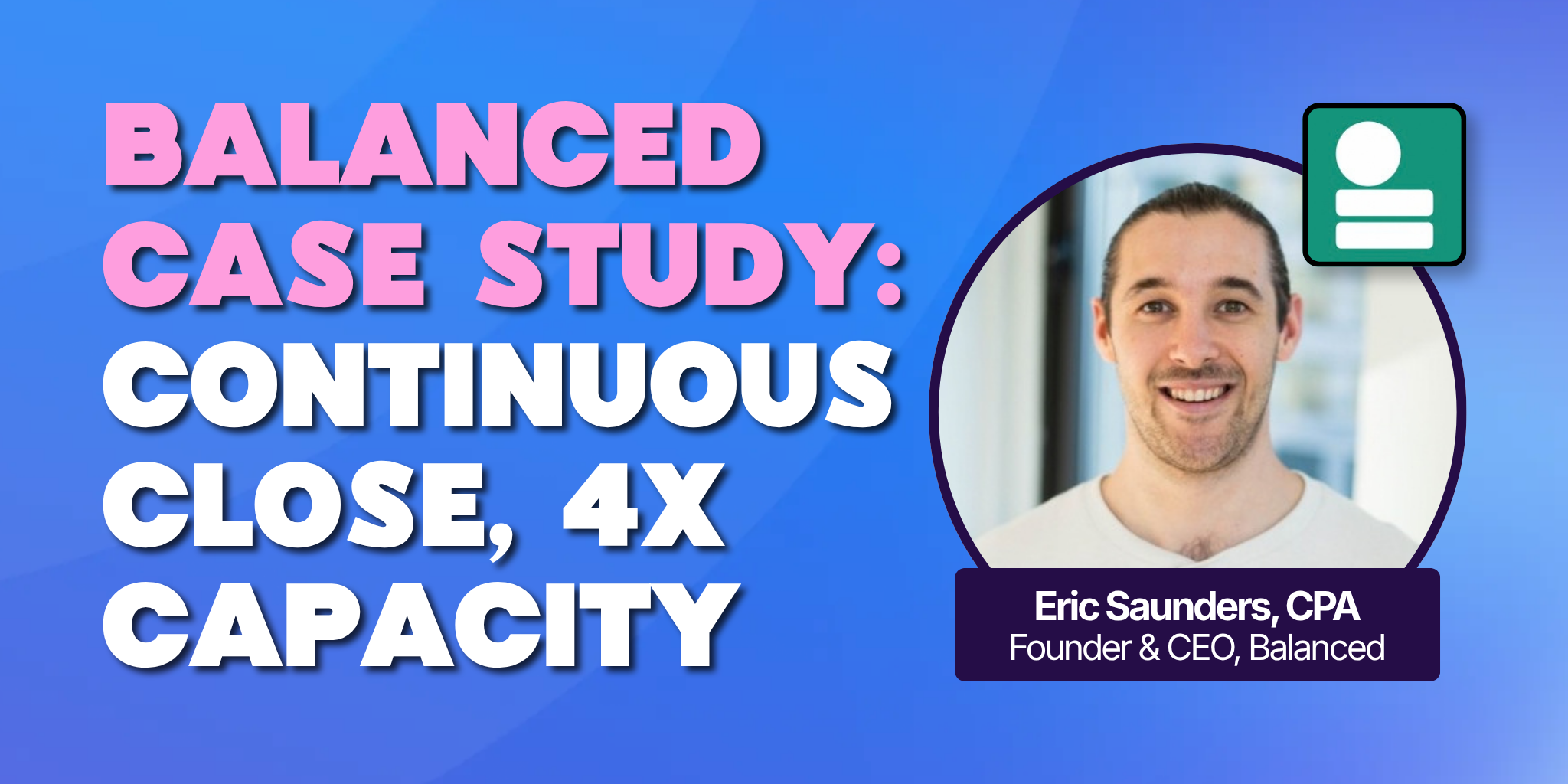
Eric Saunders has worked the month-end close from multiple angles. He first ran accounting in-house at startups, then founded Balanced accounting firm. He built the firm on FinOptimal from the start. Every Balanced client runs on Accruer, Booker, and Wrangler, and the firm's month looks different because of it.
At the startups Eric worked for before Balanced, the close was manual. Prepaids and accruals were a single monthly entry that took about a day to put together. Management reporting took several days every month.
At one real estate startup, leadership wanted reports broken out by location and region. Building them used up the time Eric needed to understand them.
"I spent so much time building those reports that I wasn't able to spend any time analyzing them."
That experience shaped how he set up his own firm, and what he looked to build with FinOptimal. In his view, most of what FinOptimal handles is mundane data entry across systems. Taking it off the team's plate frees up time for the strategic work.
Accruer on every client. Accrual work used to require a senior accountant. With Accruer, a junior team member tags the transaction with its service dates, and Accruer books the entries. The senior accountant reviews the result at month-end.
"Historically, accruals were done by a senior accountant or higher. Now, because all we need to do is tag the entry with the dates, we can push that down. All they need to do is tag it. And then the senior's job is just to review it at the end of the month."
Booker for a daily flow of data. Balanced built its own integrations into client systems like Stripe. Those integrations send raw data to a spreadsheet, formulas shape it into a Booker tab, and Booker books it into QuickBooks. The books update every day. While other firms are only exporting and cleaning up data once a month, Balanced is updated every single day, and clients can always see their current books.
Booker Unlimited's Editor for new-client cleanup. Most new clients arrive with messy books. When Balanced onboards a client, the team uses Booker's Editor tool to pull the client's full vendor history and the accounts each vendor has been booked to. Then they work together to clean up the books: Remap vendors, and restructure the chart of accounts in bulk.
"The first couple weeks of a new client is always the time where you want to give them the most attention and show them that they're a priority. When we're able to drastically change their books that quickly because of Editor, I think it's a home run every single time for clients."
Wrangler dashboards. Every Balanced client has at least one Google Sheets dashboard, and some have as many as ten. Wrangler feeds them live QuickBooks data. The team also uses Wrangler to feed data into client models.
The FinOptimal MCP for quick edits. Eric uses the FinOptimal MCP for quick, real-time changes, like bulk-editing data or running research on a client's books. For larger edits he still prefers working in a spreadsheet. He plans to use the MCP next to automate new-client setup, like generating spreadsheet templates from minute one.
A continuous close. Because data flows into QuickBooks daily, the team catches issues during the month instead of at month-end. That shortens the close for every client.
"For firms, I want to offer all my clients financials ASAP. The continuous close allows us to check issues during the month as opposed to waiting until the end of the month."
Financials on day one. Balanced now gives clients a flash revenue report on the first business day after month-end. It's about 90% accurate. Final financials follow a few days later. Eric says clients have responded well, because the traditional firm relationship leaves them waiting.
"If you're a business owner, you want to know where your cash is during the month and you want to know what your revenue is in the middle of the month."
The continuous close also helps Balanced win new clients. It's a concrete difference Eric can describe in a sales conversation.
More clients per person. Eric tracks clients per employee, and he credits FinOptimal with keeping that ratio strong. Balanced is hiring ahead of its growth, but by his estimate, the firm could run its existing client list with about a quarter of the staff a manual process would need. FinOptimal’s tools standardized across his stack means that fewer people can do more, and more strategic, work.
A calmer first week of the month. Work that used to pile up at month-end now happens throughout the month. This means cleaner books, less monthly chaos, and a happier team.
"It's definitely a time savings, but it's also an impact on the health and wellness of my team, who doesn't need to scramble in the first week of the month as much to get stuff done."
Balanced didn't roll out FinOptimal in a single training push. People joined at different times and learned it on the job. Every spreadsheet at the firm has Booker or Wrangler built in, so new hires pick it up quickly. Eric trains people directly as well.
He's candid that Booker takes more skill than Accruer. Getting raw data into the right format for the Booker tab can require solid Google Sheets and formula knowledge. He says AI tools and the FinOptimal MCP are making that step easier.
Eric's answer for firms that say they don't have time to implement is to start with Accruer.
"Accruer is so intuitive. You're throwing away hours a month doing this manually, and you're not going to lose time setting it up. It does feel like magic the first time you do it. Try it on one expense for one month and you'll immediately feel the satisfaction that comes with it."
If you want to unlock firm efficiencies and deliver a continuous close for your clients, get a custom demo from FinOptimal’s product experts.